


Tar and Wood Vinegar Control in Biomass Pyrolysis
Biomass pyrolysis converts organic feedstock into a combination of biochar, condensable liquid, and non-condensable gas under oxygen-limited conditions. During this thermal conversion, complex organic vapors are released from the biomass. Depending on the operating conditions and downstream condensation process, these vapors may form tar and wood vinegar.
Both products can have commercial value, but uncontrolled accumulation or poor separation can create operational challenges. Tar may foul pipelines, condensers, and gas treatment equipment, while wood vinegar requires appropriate collection and quality management.
Effective control therefore focuses on regulating vapor formation, optimizing thermal conditions, and designing an appropriate condensation and separation system.
Formation Mechanisms of Tar and Wood Vinegar
The formation of condensable products is closely related to the decomposition behavior of biomass pyrolysis.
Cellulose and hemicellulose generate a variety of oxygenated compounds during thermal degradation. These compounds can condense into an aqueous acidic fraction commonly associated with wood vinegar.
Lignin behaves differently. Its complex aromatic structure decomposes gradually over a broad temperature range and produces phenolic compounds, heavier organic vapors, and tar precursors.
The final composition of the condensable fraction depends on feedstock chemistry, heating rate, reactor temperature, and vapor residence time.
At lower thermal severity, primary pyrolysis vapors may remain relatively abundant. Under more severe conditions, secondary cracking and reforming reactions can alter the composition of the vapor stream.
Understanding these reaction pathways is essential for controlling the distribution between biochar, condensable liquid, and gas.
Temperature Control and Vapor Residence Time
Thermal conditions are among the most important variables affecting tar formation.
If the reactor temperature is too low or heat transfer is insufficient, incomplete vapor conversion may result in heavier condensable compounds. These compounds can condense prematurely and accumulate within the reactor or transfer lines.
Conversely, excessively high temperatures and prolonged vapor residence times may promote secondary reactions. Heavy organic molecules can undergo cracking, while smaller molecules may recombine through secondary polymerization pathways.
Precise control of reactor temperature helps maintain a predictable product distribution. The optimal operating range depends on the feedstock and the desired output.
Vapor residence time should also be carefully controlled. Rapid removal of pyrolysis vapors from the high-temperature reaction zone can reduce secondary reactions and improve product consistency.
Preventing Tar Condensation and Fouling
Tar becomes particularly problematic when vapor temperature falls below the condensation threshold before the vapor reaches the intended collection stage.
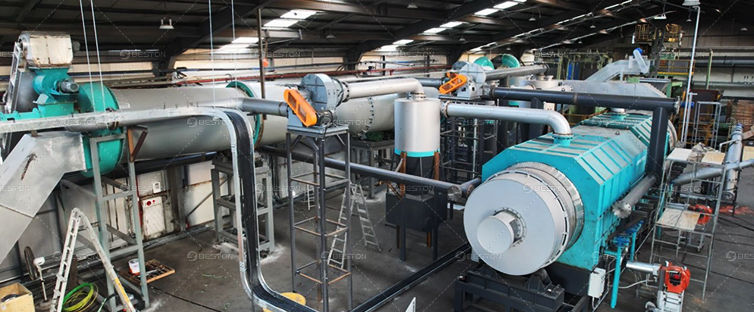
This can cause heavy organic compounds to deposit on biochar pyrolysis reactor walls, pipelines, valves, and heat exchangers. Over time, such deposits can restrict flow and reduce heat transfer efficiency.
Thermal insulation of vapor pipelines helps prevent premature condensation. Maintaining appropriate gas velocity and minimizing unnecessary bends or dead zones can also reduce deposition.
Regular inspection and cleaning are important for maintaining stable operation. However, effective system design should prioritize prevention rather than relying solely on periodic removal of accumulated deposits.
The layout of the vapor transfer system should therefore be considered during the initial engineering stage.
Wood Vinegar Collection and Separation
Wood vinegar is primarily an aqueous condensate containing organic acids, phenolic compounds, ketones, aldehydes, and other water-soluble substances.
The composition of wood vinegar varies according to feedstock and pyrolysis conditions. Its commercial applications may include agricultural inputs, odor control, and certain industrial uses, subject to applicable quality and regulatory requirements.
Effective collection requires controlled cooling of pyrolysis vapor. A staged condensation system can separate different fractions according to their condensation characteristics.
The first condensation stage may recover heavier organic compounds, while subsequent cooling stages capture lighter condensable components and water-rich fractions.
This fractionation approach can improve product quality and reduce the amount of heavy tar entering downstream systems.
Gas Cleaning and Secondary Tar Control
Not all condensable compounds are captured during primary condensation. Residual tar may remain in the non-condensable gas stream and require additional treatment.
Depending on system requirements, gas cleaning may incorporate filtration, scrubbing, adsorption, catalytic conversion, or thermal oxidation.
The selection of gas treatment technology depends on the intended use of the gas. If the gas is recycled as a process fuel, sufficient purification is required to prevent tar accumulation in burners and pipelines.
If the gas is used for other applications, additional purification may be necessary to meet equipment and environmental requirements.
Feedstock Preparation and Process Stability
Feedstock properties have a direct influence on tar and wood vinegar formation. Moisture content, particle size, chemical composition, and feedstock uniformity all affect heat transfer and reaction kinetics.
High moisture content increases the water fraction of the condensate and can alter the composition of the resulting wood vinegar. Excessive moisture also increases energy demand.
Consistent particle size promotes more uniform heating and reduces thermal gradients inside the reactor. Stable feeding further improves process predictability.
These upstream controls can significantly simplify downstream condensation and separation.
Designing an Integrated Condensable Product Management System
Effective tar and wood vinegar control requires coordination between the reactor, vapor transfer system, condensation equipment, and gas treatment unit.
The objective is not necessarily to eliminate condensable products. Instead, the goal is to control their formation, separate them efficiently, and prevent unwanted deposition within the process system.
A well-designed biomass pyrolysis facility can recover valuable condensable fractions while maintaining stable gas circulation and reducing maintenance requirements.
By optimizing feedstock preparation, reactor temperature, vapor residence time, condensation stages, and gas purification, biomass pyrolysis projects can achieve better control over tar formation and wood vinegar quality. This integrated approach improves operational reliability while creating opportunities to convert complex pyrolysis vapors into useful products rather than treating them as unwanted residues.


Comments